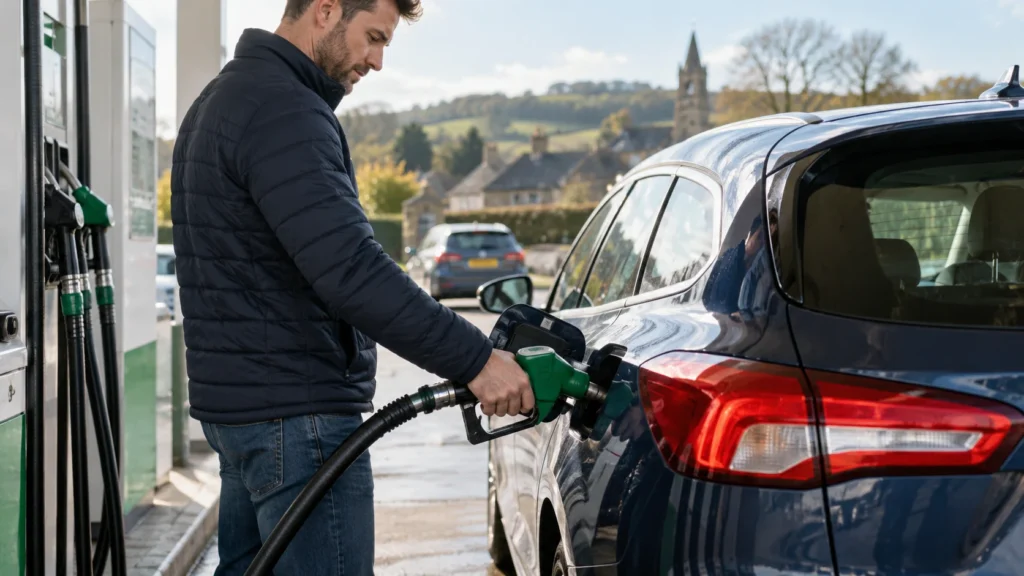
The MPG figure on your dashboard is useful, but your receipts reveal what driving actually costs. A full-to-full fuel check gives you a measured figure for your own car and journeys.
You need the distance travelled, the litres used and the price paid. Keep those records over several fills and you can compare vehicles, budget for journeys or investigate falling fuel economy.
Measure fuel from full to full
Fill the tank until the nozzle first clicks off, then record the mileage or reset the trip counter. Do not keep topping up after that initial automatic stop. The first fill establishes your starting level.
Drive normally, then refill to the same first-click point. Record the miles since the first fill and the litres added at the second fill. Those replacement litres approximate the fuel used over that distance.
Use the same pump and similar parking position where possible. Differences in nozzle shut-off and vehicle angle can affect a single reading. Repeat the process across several tanks to reduce that variation.
Calculate UK miles per gallon
Multiply miles travelled by 4.54609, then divide by litres used. The conversion matters because a UK imperial gallon contains 4.54609 litres. A US gallon is smaller, so US MPG gives a different number.
Suppose you drive 400 miles and add 42 litres at the next fill. The calculation is 400 multiplied by 4.54609, divided by 42. Your result is 43.30mpg.
For several tanks, add all the miles and all the replacement litres before doing the calculation. Do not simply average individual MPG readings when the distances or fuel quantities differ.
Turn that figure into pence per mile
For a receipt-based replacement-cost estimate, divide the refill cost in pounds by miles travelled, then multiply by 100. Suppose those 42 litres cost £1.75 each. The refill costs £73.50. Dividing £73.50 by 400 miles gives 18.38p per mile.
The £1.75 price is an example, not a claim about today’s national average. This method values the used fuel at its replacement price. It does not track exactly what you originally paid for every litre remaining in the tank.
If you already know your real MPG, another formula gives the same answer. Multiply fuel price in pence per litre by 4.54609, then divide by MPG. Keep the unrounded MPG until the final calculation.
Calculate a journey or annual budget
At 18.38p per mile, a 250-mile trip needs approximately £45.94 of fuel using the unrounded calculation. Driving 10,000 miles at the same consumption and price would cost approximately £1,838.
Use an MPG figure that suits the planned journey. A short urban commute and a long motorway trip can produce different results. Fuel prices can also change before you travel.
For an annual budget, use several months of records if available. That gives cold starts, heating demands and seasonal journeys more chance to appear in your figures.
Understand what the result excludes
Fuel cost per mile does not include insurance, tax, servicing, tyres or depreciation. Add those separately if you want the total cost of owning the car.
A sudden deterioration deserves a check, but one poor tank does not prove a mechanical fault. Traffic, short journeys, extra weight and tyre pressures can change consumption. Look for a repeated pattern under similar conditions.
If you drive a plug-in hybrid, record charging costs alongside petrol receipts. Petrol MPG alone can make its running costs look artificially low.
Once you know your measured fuel cost, you have a useful starting point for any replacement-car comparison. You can then judge claimed savings against what your current car actually costs you. To compare your measured fuel cost with an electric car, pick your car in our EV fuel savings calculator, or choose “Not listed? Enter vehicle” and type in your mpg.